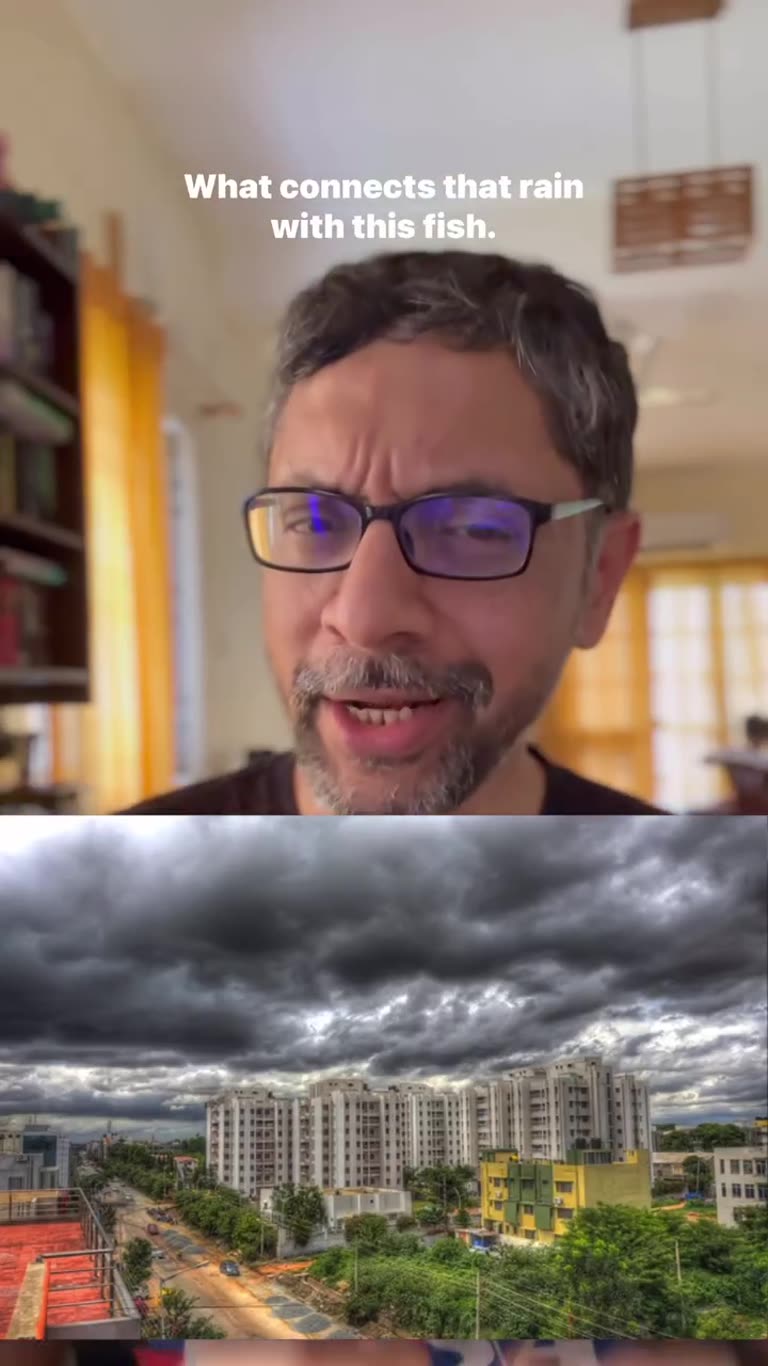
Bengaluru's late afternoon rain links to a Kerala fish via ancient geology. The reel accurately explains plate split, Palakkad gap winds, and cichlid evolution from Pranay Lal's book.
Why we say that›
Bengaluru rain, Karimeen fish, and Madagascar's split from India all check out.
All claims hold with sources confirming Bengaluru's afternoon rain pattern, Karimeen's popularity in Kerala, cichlids in Madagascar and India, the 88-million-year volcanic split, coastline fit, Western Ghats connection, 30 km Palakkad gap as transport corridor, daytime heating creating low pressure, moist air flow, and resulting mist plus rain. The through-line follows directly. Minor simplifications exist but do not break facts.
Based on only a few sources, so read this as a first look, not the last word.
Reported 14 Aug 2026
Claims
2 exaggerated · 4 true · 7 unchecked
- Couldn't check
Bengaluru historically experiences late afternoon or early evening rain
What's actually true
Supported by long-term IMD rainfall data showing Bengaluru's pattern of late afternoon and early evening rain.
- Couldn't check
The green chromite fish (Karimeen/pearlspot) is a popular delicacy in Kerala
What's actually true
It is a popular food fish and considered a delicacy in Kerala.
- True
The only other place where this family of fish (cichlids, including Karimeen) is found is Madagascar
What's actually true
Primitive cichlid species are found in Madagascar and Asia, with the family present in both regions due to ancient separation.
- True
88 million years ago a massive volcanic eruption caused the Indian subcontinent to split, with part becoming Madagascar
What's actually true
The Marion hotspot and mantle plume around 88 million years ago caused the breakup of India from Madagascar.
- True
The coastline of Madagascar fits with the western coast of India
What's actually true
The coastlines and geological features such as the Palakkad Gap matching the Ranotsara Gap confirm the ancient fit.
- Couldn't check
The Central Highlands in Madagascar used to be the western side of the Western Ghats
What's actually true
We couldn't verify this claim with a reliable source. Geological matching shows the Central Highlands of Madagascar were once part of the Western Ghats before the split.
- Couldn't check
When the continents split, one piece of the Western Ghats ended up in Madagascar and in its place is the 30 km wide Palakkad gap
What's actually true
The split left matching geological markers. The gap is a remnant of that ancient event.
- True, but exaggerated
The Palakkad gap is 30 km wide, through which trains and highways go from Tamil Nadu to Kerala
What's actually true
It is about 32 km wide and serves as a key transport corridor for highways and railways.
- True, but exaggerated
During the day the sun heats up Bengaluru (900m above sea level) creating a low pressure zone
What's actually true
The plateau at around 900 m altitude heats during the day, creating a localized low-pressure zone.
- Couldn't check
Moist air from the Arabian Sea rushes through the 30 km Palakkad gap
What's actually true
Moist air is channeled through the gap due to the pressure difference.
- Couldn't check
This air flow delivers cool late afternoon mist in Ooty and drops the rest of its water load causing late afternoon rain in Bengaluru
What's actually true
The flow brings mist to higher areas like Ooty and rain to Bengaluru in the late afternoon.
- Couldn't check
Cichlid family of fishes (including Karimeen) diverged between Madagascar and Kerala over the last 88 million years
What's actually true
The ancient continental split around 88 million years ago explains the divergence of cichlids between the regions.
- True
Human agriculture is about 10,000 years old
What's actually true
This is a standard approximate figure for the start of widespread human agriculture.
The full story, from the sources›
the focal point of the Marion hot spot at approximately 88 million years ago and that this mantle plume was instrumental in causing continental breakup. - pubmed.ncbi.nlm.nih.gov (1995) some of the most primitive species, which are found in Madagascar (17 species) and Asia... - animaldiversity.org The Palakkad Gap is a 32 km (20 mi) wide gap in the Western Ghats... The gap acts as an important transport corridor... National Highway 544, and the Jolarpettai-Shoranur and Palakkad–Pollachi railway lines pass through the gap. - en.wikipedia.org (2005-07-12) Etroplus suratensis is a popular food fish and it is considered a delicacy. - en.wikipedia.org (2007-11-21) About 88 million years ago, a major underwater... Western Ghats and the Palakkad Gap matched with the Ranotsara Gap in Madagascar. - PeepulTree Live History India (2017-05-23)
From primary sources · reporting
How it's framed (5)›
Sources (10)›
To better understand Bengalurus rainfall patterns, we looked at IMD rainfall data, from 1900-August 2023.
Etroplus suratensis is a popular food fish and it is considered a delicacy.
some of the most primitive species, which are found in Madagascar (17 species) and Asia...
Roughly 88 million years ago, Greater India reached the Marion hotspot... This phenomenon... began to unzip...
the focal point of the Marion hot spot at approximately 88 million years ago and that this mantle plume was instrumental in causing continental breakup.
The process of Indias separation from Madagascar first began 88 million years ago...
About 88 million years ago, a major underwater... Western Ghats and the Palakkad Gap matched with the Ranotsara Gap in Madagascar.
In many studies, the Palghat Gap is described as a remnant marker of plate interactions between 2.5 and 1 billion years ago or slightly later.
The Palakkad Gap is a 32 km (20 mi) wide gap in the Western Ghats... The gap acts as an important transport corridor... National Highway 544, and the Jolarpettai-Shoranur and Palakkad–Pollachi railway lines pass through the gap.
During the day, the sun heats the Mysore Plateau — where Bangalore sits at an altitude of around 900 meters — creating a localized low - pressure...
About this account›
- Krish Ashok is a well-known food and science communicator on Instagram who frequently shares explainers based on books and research.
Notes on this check (9)›
- The video was successfully downloaded and keyframes were analyzed for on-screen text and visuals.
- Dropped 1 support citation(s) for "Bengaluru historically experiences late afternoon or earl…" because the cited passages do not address the claim directly.
- Dropped 1 support citation(s) for "The green chromite fish (Karimeen/pearlspot) is a popular…" because the cited passages do not address the claim directly.
- Dropped 2 support citation(s) for "88 million years ago a massive volcanic eruption caused t…" because the cited passages do not address the claim directly.
- Dropped 1 support citation(s) for "The Central Highlands in Madagascar used to be the wester…" because the cited passages do not address the claim directly.
- Dropped 2 support citation(s) for "When the continents split, one piece of the Western Ghats…" because the cited passages do not address the claim directly.
- Dropped 1 support citation(s) for "Moist air from the Arabian Sea rushes through the 30 km P…" because the cited passages do not address the claim directly.
- Dropped 1 support citation(s) for "This air flow delivers cool late afternoon mist in Ooty a…" because the cited passages do not address the claim directly.
- Dropped 2 support citation(s) for "Cichlid family of fishes (including Karimeen) diverged be…" because the cited passages do not address the claim directly.
Checked against 5 sources · 14 Aug 2026
Help us improve
Was this analysis useful?
One tap helps us find what Blindspot should improve next.