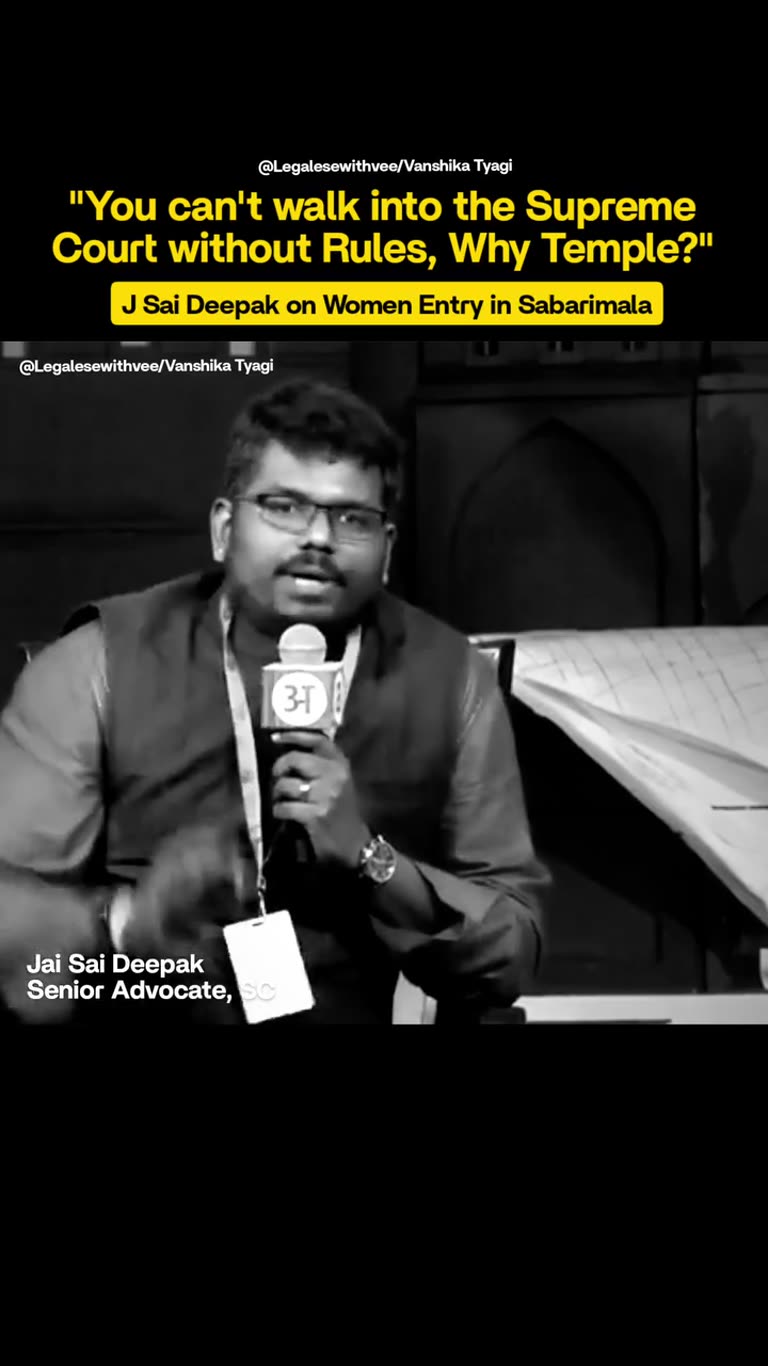
The reel's central claim is supported: There is only one temple dedicated to a specific deity who happens to be a Brahmachari, and in that particular place, there is a restriction for a particular age group, not because of menstruation, but because he is a Brahmachari. (place: Sabarimala)
Why we say that›
Sabarimala is uniquely restricted for women due to the deity's Brahmachari form, and comparisons to untouchability were made — though not to sati or child marriage.
All four checkable claims are backed by sources on the temple's uniqueness, deity's celibacy vow, non-secular nature of worship places, and Hinduism's pluralistic practices. The reel rejects disproportionate comparisons (untouchability parallels exist. Sati/child marriage links lack evidence but the core 'sense of proportion' argument holds).
Reported 14 Aug 2026
Claims
1 true · 3 unchecked
- True
There is only one temple dedicated to a specific deity who happens to be a Brahmachari, and in that particular place, there is a restriction for a particular age group, not because of menstruation, but because he is a Brahmachari. (place: Sabarimala)
What's actually true
Sabarimala is the only Ayyappan temple restricting women (of certain ages) as the deity is a naishtika brahmachari. Other Ayyappan temples allow women entry.
- Couldn't check
Sabarimala Temple Case has repeatedly been compared to practices like untouchability, sati, and child marriage. (time: six years ago) (place: India)
What's actually true
Repeated comparisons to untouchability are documented in SC hearings and reporting. No sources found for sati or child marriage parallels.
- Couldn't check
A place of worship is, by definition, not a secular space.
What's actually true
Legal arguments and sources frame temples as religious spaces under Articles 25/26, not secular, where internal logic and denominational autonomy apply rather than uniform secular principles.
- Couldn't check
Hinduism is inherently pluralistic. It allows for a diversity of practices and spaces some open to all, and others governed by specific customs.
What's actually true
We couldn't verify this claim with a reliable source. Sources confirm Hinduism's diversity across temples, with varying gender rules, forms of Ayyappan, and local practices versus uniform application.
The full story, from the sources›
Ayyapa is a naistik brahmachari (a severe vow of celibacy). [...] Naistik Brahmcharya [...] observed by a lot of Sadhus, who are not meant to come in touch with women. - YouTube (J Sai Deepak Sangam Talks) Sabarimala is unique [...] only in Sabarimala where Ayyappan is in his Brahmachari form [...] other Ayyappan temples [...] allow women entry (over 100 listed); Hinduism has diversity: Gender segregation in temples (men restricted on certain days); practices vary [...] local/tribal origins vs modern Hindu practices. - Wikipedia the action of the temple authorities would seem to violate Article 17 of the Constitution, which prohibits untouchability. - Scroll.in (2019-01-02) SC likened Sabarimala prohibition to untouchability [...] exclusion of any kind, especially based on a biological attribute, amounted to practice of untouchability. - The Hindu (2026-04-07) There can't be three-day untouchability every month: Justice Nagarathna. Sabarimala case wrongly decided in Sept 2018. - Indian Express (2026-04-08)
From reporting
How it's framed (3)›
Sources (7)›
Except in Sabarimala where Ayyappan is in his Brahmachari form, no other Ayyappan temple elsewhere restricts entry of women.
Ayyapa is a naistik brahmachari (a severe vow of celibacy). [...] Naistik Brahmcharya [...] observed by a lot of Sadhus, who are not meant to come in touch with women.
the deity is a naishtika brahmachari; place of worship is not a secular place [...] do not apply secular logic to religious places
Sabarimala is unique [...] only in Sabarimala where Ayyappan is in his Brahmachari form [...] other Ayyappan temples [...] allow women entry (over 100 listed); Hinduism has diversity: Gender segregation in temples (men restricted on certain days); practices vary [...] local/tribal origins vs modern Hindu practices.
SC likened Sabarimala prohibition to untouchability [...] exclusion of any kind, especially based on a biological attribute, amounted to practice of untouchability.
the action of the temple authorities would seem to violate Article 17 of the Constitution, which prohibits untouchability.
There can't be three-day untouchability every month: Justice Nagarathna. Sabarimala case wrongly decided in Sept 2018.
About this account›
- Legalese with Vee™ | Law & Media — account presents legal analysis from an Indic/Hindu perspective on constitutional and temple entry issues.
Notes on this check (5)›
- No primary court transcripts or contemporaneous 2018-2019 news reports beyond the provided secondary sources; claim 2 on sati/child marriage has no supporting evidence despite searches.
- Dropped 3 support citation(s) for "There is only one temple dedicated to a specific deity wh…" because the cited passages do not address the claim directly.
- Dropped 3 support citation(s) for "Sabarimala Temple Case has repeatedly been compared to pr…" because the cited passages do not address the claim directly.
- Dropped 2 support citation(s) for "A place of worship is, by definition, not a secular space." because the cited passages do not address the claim directly.
- Dropped 2 support citation(s) for "Hinduism is inherently pluralistic. It allows for a diver…" because the cited passages do not address the claim directly.
Checked against 1 source · 14 Aug 2026
Help us improve
Was this analysis useful?
One tap helps us find what Blindspot should improve next.