Blending and rainfall effects are real. No source shows blending caused a shortage or that restrictions and price rises are planned.
Why we say that›
Ethanol blending and lower rainfall in two states are documented, yet no evidence shows government plans to curb ethanol use or rising sugar prices.
Supported facts cover ethanol blending since 2004 and rainfall cuts in Maharashtra and Karnataka. The causal sequence from blending to shortage fears, restrictions, and price rises rests on unsupported predictions. Searches found no announcements or data for the claimed October 2026 curbs.
Based on only a few sources, so read this as a first look, not the last word.
Ethanol blending turned India's sugarcane excess into a shortage that will force government curbs on ethanol feedstock and raise sugar prices.
Reported 15 Aug 2026
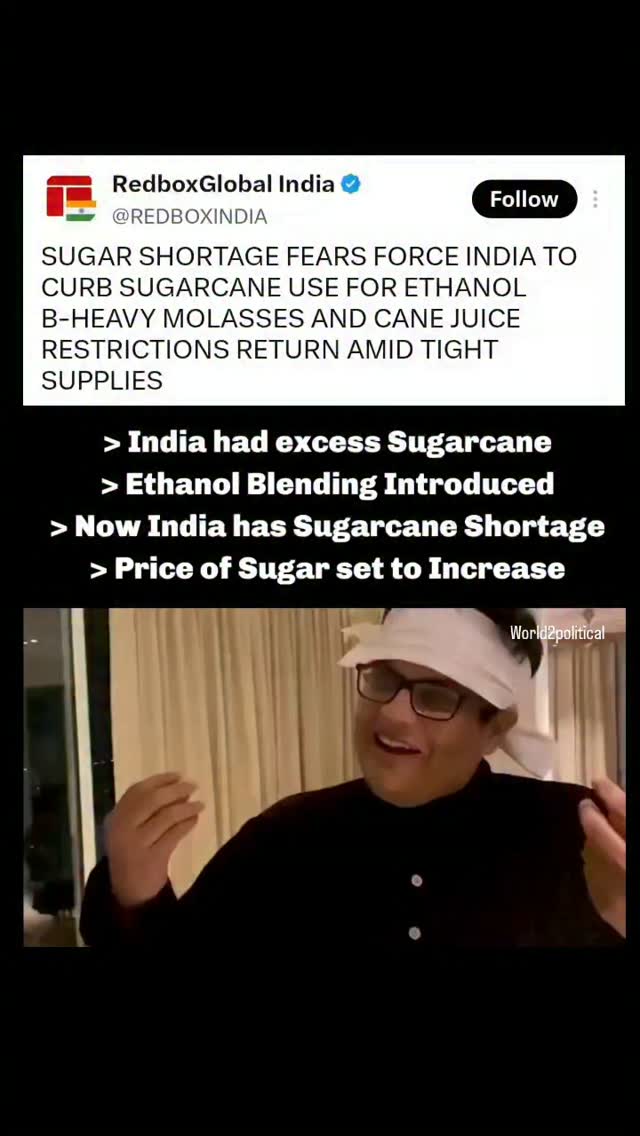
How the reel gets there
The reel says: “> India had excess Sugarcane > Ethanol Blending Introduced > Now India has Sugarcane Shortage > Price of Sugar set to Increase”
The record shows: Current sugar production is estimated at around 27.9 million tonnes, close to India's annual domestic consumption of about 28.5 million tonnes, leaving limited room for exports; reduced rainfall in Maharashtra and Karnataka has tightened sugarcane output.
Business Standard
Claims
1 true · 7 unchecked
- Couldn't check
India now has a sugarcane shortage.
What's actually true
Sugar output is near consumption at 27.9 million tonnes versus 28.5 million tonnes with stock concerns and export ban till September 2026.
- Couldn't check
The price of sugar is set to increase.
What's actually true
No source states prices are set to rise or are record high.
- Couldn't check
Sugar shortage fears are forcing India to curb sugarcane use for ethanol.
What's actually true
We couldn't verify this claim with a reliable source. No source shows government plans to curb ethanol use starting October 2026.
- Couldn't check
India's government is considering restrictions on sugarcane juice and B-heavy molasses for ethanol production starting October 2026 to boost sugar supplies amid record-high prices and shortage fears.
What's actually true
We couldn't verify this claim with a reliable source. No source confirms any October 2026 restriction proposal or record-high prices.
- Couldn't check
India had excess sugarcane.
What's actually true
We couldn't verify this claim with a reliable source. No source confirms a pre-ethanol surplus as a distinct historical fact.
- Couldn't check
B-heavy molasses and cane juice restrictions return amid tight supplies.
What's actually true
We couldn't verify this claim with a reliable source. No source confirms any return of B-heavy molasses or cane juice restrictions starting October 2026.
- Couldn't check
Reduced rainfall in Maharashtra and Karnataka has tightened sugarcane output.
What's actually true
El Nino has reduced rainfall and sugarcane productivity in rainfed regions including Maharashtra and Karnataka.
- True
Ethanol blending was introduced.
What's actually true
Pilot ethanol blending started in 2001 and was formally announced in 2004.
The full story, from the sources›
2001: A pilot ethanol blending programme was launched. 2004: The programme was formally announced. 2006: E5, or 5 percent blending, rolled out... - Press Information Bureau India's ethanol blending programme has emerged as one of the countrys most ambitious energy initiatives. - India Today (2026-06-11) current sugar production is estimated at around 27.9 million tonnes, close to Indias annual domestic consumption of about 28.5 million tonnes, leaving limited room for exports. - Business Standard (2026-06-23) The ethanol programme creates a stable market for sugarcane, maize, and other feedstocks. It helps absorb surplus agricultural production. - shankariasparliament.com (2026-07-10)
From primary sources · reporting
How it's framed (2)›
Sources (4)›
current sugar production is estimated at around 27.9 million tonnes, close to Indias annual domestic consumption of about 28.5 million tonnes, leaving limited room for exports.
India's ethanol blending programme has emerged as one of the countrys most ambitious energy initiatives.
The ethanol programme creates a stable market for sugarcane, maize, and other feedstocks. It helps absorb surplus agricultural production
2001: A pilot ethanol blending programme was launched. 2004: The programme was formally announced. 2006: E5, or 5 percent blending, rolled out...
Notes on this check (5)›
- Unavailable: audio transcript (transcription unavailable)
- No speech transcript - analysis rests on caption, on-screen text, and frames.
- The reel's central argument depends on claims that were not independently established, so it is reported as misleading context rather than as facts with a false point.
- Dropped 1 support citation(s) for "India now has a sugarcane shortage." because the cited passages do not address the claim directly.
- Dropped 1 support citation(s) for "Reduced rainfall in Maharashtra and Karnataka has tighten…" because the cited passages do not address the claim directly.
Checked against 1 source · 15 Aug 2026
Help us improve
Was this analysis useful?
One tap helps us find what Blindspot should improve next.