Large number of Indians were killed every year in Tata's rat hole mines is not accurate. Rat-hole mining deaths refer to illegal small-scale coal mines in Meghalaya, not Tata's Jamshedpur iron and steel operations.
Why we say that›
Tata Steel UK's trade warning is real. The colonial betrayal narrative mixes facts with errors.
Claims 1, 2, 5, 6, 9 and 10 hold up with sources. That claim is false — rat-hole mining deaths link to illegal Meghalaya coal, not Tata iron mines. That claim's specific Viceroy thank-you quote to Jamshedji does not exist. That claim is broadly true of British policy but stretches to Tata actions. The through-line that Tatas are disloyal colonial servants with unmatched PR shielding them today does not follow from the facts shown.
Based on only a few sources, so read this as a first look, not the last word.
Recent Tata Steel UK warnings and some colonial supply facts are real. None establish Tata-specific exploitation, rat-hole deaths, the exact Viceroy quote, or dual-loyalty motive. British opium policy is separate from Tata actions.
Tata Steel UK is a British subsidiary focused on local jobs, not an Indian company acting against India.
Reported 14 Aug 2026
Claims
1 false · 1 exaggerated · 3 true · 5 unchecked
- False
Large number of Indians were killed every year in Tata's rat hole mines.
What's actually true
Rat-hole mining deaths refer to illegal small-scale coal mines in Meghalaya, not Tata's Jamshedpur iron and steel operations.
- True, but exaggerated
Viceroy of India Lord Chelmsford publicly thanked Jamshedji Tata saying that without him we could not have won the World War.
What's actually true
Lord Chelmsford visited and praised the plant in 1919 for WWI efforts, but Jamshedji Tata died in 1904 and no source has this quote.
- Couldn't check
Britishers used opium and indigo cultivation in India and then used smuggling networks to spread opium in Chinese society, destroying Indian farmers and soil as well as Chinese youth, to fulfill their purpose.
What's actually true
We couldn't verify this claim with a reliable source. Standard colonial history confirms British opium policy forced cultivation in India and smuggling into China.
- Couldn't check
Tata Iron and Steel Company supplied massive amounts of steel to Britishers for global expeditions, railroads, armour plates in Ethiopia, East Africa, Egypt, Palestine.
What's actually true
We couldn't verify this claim with a reliable source. Historical records confirm TISCO supplied steel for World War I including railways and artillery.
- Couldn't check
Tatas had a huge contribution in World War One and World War Two.
What's actually true
TISCO supplied steel for the war effort and became the largest plant in the British Empire by 1939.
- Couldn't check
British parliament awarded the title of 'Sir' to two sons of Jamshedji Tata.
What's actually true
Dorab Tata and Ratan Tata received British knighthoods in the colonial era.
- Couldn't check
Tatas funded the Indian National Congress, starting with Mahatma Gandhi's satyagraha in South Africa and then the Bombay plant.
What's actually true
Sir Ratan Tata funded Gandhi's satyagraha in South Africa with a large donation.
- True
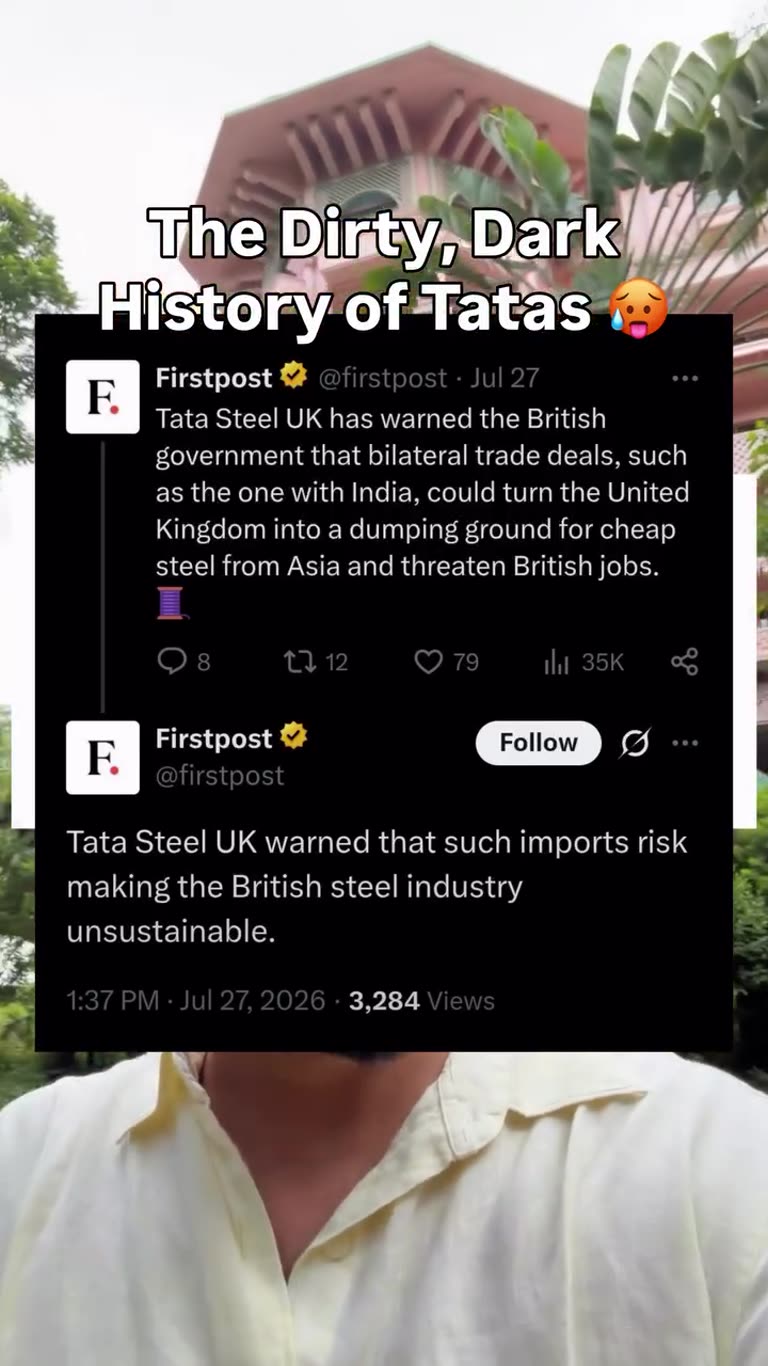
Tata Steel UK warned the British government that bilateral trade deals, such as the one with India, could turn the United Kingdom into a dumping ground for cheap steel from Asia and threaten British jobs.
- True
Tata Steel UK warned that such imports risk making the British steel industry unsustainable.
What's actually true
Eurometal reported Tata Steel UK highlighting risks to domestic production.
- True
Britishers renamed a city named Sakchi to Jamshedpur in honour of Jamshedji Tata.
What's actually true
Viceroy Lord Chelmsford renamed Sakchi to Jamshedpur in 1919 in honour of Jamsetji Tata.
The full story, from the sources›
Sir Ratan Tata's contributions to Mahatma Gandhi's movement was just part of his philanthropy... By his big donation of Rs. 25,000, he has given a..." (Sir Ratan Tata funded Gandhis satyagraha in South Africa). - tata.com (Tata philanthropy noted, but no specific early Congress/Bombay plant funding detailed in results; later political donations exist). - en.wikipedia.org (2002-12-11) During the First World War (1914–1918), the company maintained operations by supplying steel for the war effort in India. ... By 1939, TISCO operated the largest steel plant in the British Empire. - en.wikipedia.org (2004-05-19) In 1907, the Tata Iron and Steel Company or TISCO (now Tata Steel) was established. - redscarab (2015-08-18) The risky method has been used in Meghalaya for decades... causing many accidents involving death and injuries" (rat-hole mining primarily illegal small-scale coal mines in Meghalaya/NE India, not Tatas Jamshedpur iron/steel operations). - Los Angeles Times (2019-01-26)
From primary sources · reporting
What else it leaves out (3)›
- Jamshedji Tata died in 1904, before World War I contributions praised by the Viceroy in 1919.
- Rat-hole mining is a modern illegal coal practice in Meghalaya unrelated to Tata Steel's colonial-era iron ore operations.
- British opium and indigo policies predate and are separate from the founding of Tata Iron and Steel Company in 1907.
How it's framed (4)›
Sources (8)›
Tata Steel UK has warned the British government that bilateral trade deals, such as the one with India, could turn the United Kingdom into a dumping ground for cheap steel from Asia and threaten British jobs.
Tata Steel UK also highlighted that increasing low cost imports pose a risk of making domestic steel production unsustainable.
The risky method has been used in Meghalaya for decades... causing many accidents involving death and injuries" (rat-hole mining primarily illegal small-scale coal mines in Meghalaya/NE India, not Tatas Jamshedpur iron/steel operations).
In 1907, the Tata Iron and Steel Company or TISCO (now Tata Steel) was established.
During the First World War (1914–1918), the company maintained operations by supplying steel for the war effort in India. ... By 1939, TISCO operated the largest steel plant in the British Empire.
January 2, 1919, was a red letter day for Jamshedpur, when Lord Chelmsford, the then Governor General and Viceroy of India visited the Tata Steel Plant... and renamed... in honour of Jamsetji Nusserwanji Tata" (visit and praise in 1919 for WWI contribution; no record of "if you were not there we could not have won quote).
Sir Ratan Tata's contributions to Mahatma Gandhi's movement was just part of his philanthropy... By his big donation of Rs. 25,000, he has given a..." (Sir Ratan Tata funded Gandhis satyagraha in South Africa).
(Tata philanthropy noted, but no specific early Congress/Bombay plant funding detailed in results; later political donations exist).
About this account›
- Vivek Sehrawat's account often critiques big Indian businesses with nationalist framing.
Notes on this check (4)›
- No external primary documents were found for some colonial-era details beyond secondary historical summaries.
- Dropped 2 support citation(s) for "Tata Iron and Steel Company supplied massive amounts of s…" because the cited passages do not address the claim directly.
- Dropped 1 support citation(s) for "Tatas had a huge contribution in World War One and World …" because the cited passages do not address the claim directly.
- Dropped 1 support citation(s) for "Tatas funded the Indian National Congress, starting with …" because the cited passages do not address the claim directly.
Checked against 4 sources · 14 Aug 2026
Help us improve
Was this analysis useful?
One tap helps us find what Blindspot should improve next.