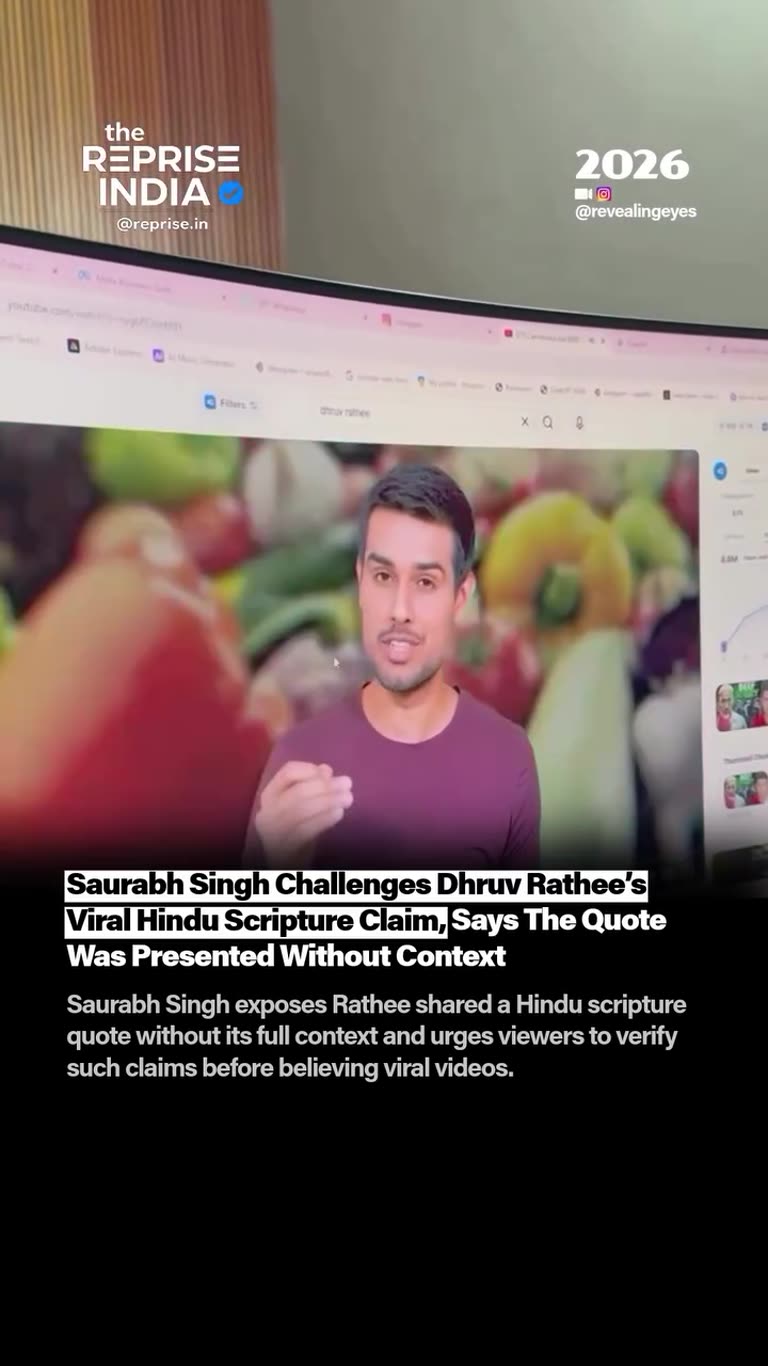
Dhruv Rathee claimed that Hindu scriptures promote only and 100% pure vegetarianism is not accurate. Rathee actually said the opposite: claiming Hindu scriptures promote only 100% vegetarianism is wrong, and cited this shloka as evidence.
Why we say that›
The Brihadaranyaka Upanishad 6.4.18 recommends eating bull meat in a fertility rite.
Claims 1 and 2 are supported by the sources and the shloka text itself. That claim is contradicted: the passage gives a direct ritual instruction, not a negative metaphor. That claim has no independent verification for this specific ChatGPT output. The through-line that Rathee took the quote out of context fails because the literal meaning matches what he presented.
Rathee's quote of the shloka is accurate and matches the literal text. The reel asserts it is a negative metaphor/example of what not to do, but primary translations show it as a recommended ritual for desiring a learned son.
The reel presents the shloka as clearly metaphorical against meat-eating, but primary translations show it as a direct ritual recommendation for fertility and producing a learned son.
Reported 14 Aug 2026
Claims
1 false · 3 unchecked
- False
Dhruv Rathee claimed that Hindu scriptures promote only and 100% pure vegetarianism.
What's actually true
Rathee actually said the opposite: claiming Hindu scriptures promote only 100% vegetarianism is wrong, and cited this shloka as evidence.
- Couldn't check
Brihadaranyaka Upanishad chapter 6 section 4 shloka 18 states that if a learned man desires a son, he should eat rice cooked with the meat of a vigorous bull along with his wife and clarified butter.
What's actually true
The shloka gives exactly this instruction as a ritual to produce a learned son.
- Couldn't check
The shloka in Brihadaranyaka Upanishad 6.4.18 is metaphorical (metaphorism), presented as an example of what should not be done, and does not recommend eating meat.
What's actually true
Primary translations present it as a literal recommended ritual, not a metaphor or negative example.
- Couldn't check
ChatGPT analysis of the shloka confirms it has a deeper, serious and contextual meaning, explaining it as metaphorical with negative consequences for the described actions.
What's actually true
No independent verification found for this exact ChatGPT output. Traditional sources treat the passage as a literal ritual.
The full story, from the sources›
He who wishes that a son should be born to him who would be a reputed scholar... should have rice cooked with the meat of a vigorous bull or one more advanced in years, and he and his wife should eat it with clarified butter. Then they would be able to produce such a son. - wisdomlib.org (2015-02-23) He who wishes that a son should be born to him who would be a reputed scholar, frequenting the assemblies and speaking delightful words, would study all the Vedas and attain a full term of life, should have rice cooked with the meat of a vigorous bull or one more advanced in years, and he and his wife should eat it with clarified butter. - VivekaVani (2016-04-18) To say that our Hindu scriptures only and 100% promote pure vegetarianism is wrong. Look at Brihadaranyaka Upanishad chapter 6 section 4 shlok 18. - Dhruv Rathee (via video resources & reporting) (2026) Dhruv Rathi... stated that Lord Ram was non-vegetarian. Based on scriptures he also narrated the food habits of many gods and the prevalence of meat eating at that time. - Countercurrents (2026-04-01)
From primary sources · reporting
What else it leaves out (1)›
- Traditional scholarly interpretations do not describe this passage as a negative example of rule-breaking driven by desire.
How it's framed (3)›
Sources (4)›
To say that our Hindu scriptures only and 100% promote pure vegetarianism is wrong. Look at Brihadaranyaka Upanishad chapter 6 section 4 shlok 18.
Dhruv Rathi... stated that Lord Ram was non-vegetarian. Based on scriptures he also narrated the food habits of many gods and the prevalence of meat eating at that time.
He who wishes that a son should be born to him who would be a reputed scholar... should have rice cooked with the meat of a vigorous bull or one more advanced in years, and he and his wife should eat it with clarified butter. Then they would be able to produce such a son.
He who wishes that a son should be born to him who would be a reputed scholar, frequenting the assemblies and speaking delightful words, would study all the Vedas and attain a full term of life, should have rice cooked with the meat of a vigorous bull or one more advanced in years, and he and his wife should eat it with clarified butter.
About this account›
- The Reprise account often critiques left-leaning or secular commentators like Dhruv Rathee on cultural and religious topics.
Notes on this check (4)›
- Searches found no independent verification of the specific ChatGPT analysis shown in the reel.
- Parts of the audio did not transcribe cleanly.
- Dropped 2 support citation(s) for "Brihadaranyaka Upanishad chapter 6 section 4 shloka 18 st…" because the cited passages do not address the claim directly.
- Dropped 2 support citation(s) for "The shloka in Brihadaranyaka Upanishad 6.4.18 is metaphor…" because the cited passages do not address the claim directly.
Checked against 1 source · 14 Aug 2026
Help us improve
Was this analysis useful?
One tap helps us find what Blindspot should improve next.