Paper result on healthy adults is real. The leap to a must-try treatment for diabetics is not supported.
Why we say that›
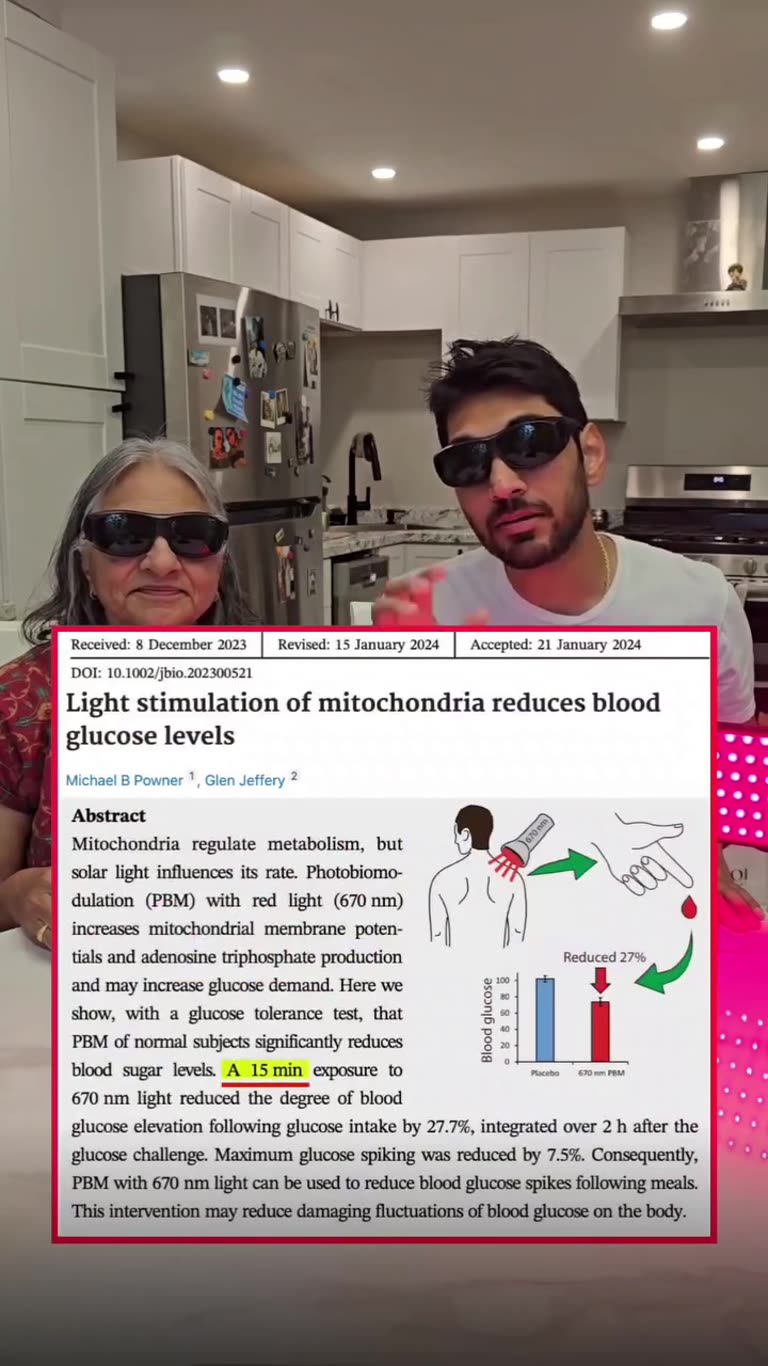
670 nm red light study records 27.7 percent reduction in healthy subjects. Reel’s mother and speaker results lack any outside source.
The cited paper’s finding holds for normal adults after a glucose challenge. Personal before-and-after numbers, graphs and 70 percent or 37 percent drops are self-reported only. The reel generalises these to diabetics and calls the method a must-try biohack.
Based on only a few sources, so read this as a first look, not the last word.
The study tested only normal healthy adults after a pure glucose drink, not diabetics after rice and dal.
Reported 4 Sept 2026
Claims
1 true · 7 unchecked
- Couldn't check
The speaker and their mother applied 670 nm red light for 15 minutes on their backs before eating 200g white rice and 200g arhar dal.
What's actually true
We couldn't verify this claim with a reliable source. No external source confirms this personal experiment.
- Couldn't check
With red light before dal chawal, the speaker's blood sugar spike was only 34 mg/dL, a 70% drop.
What's actually true
We couldn't verify this claim with a reliable source. No external source confirms this personal result.
- Couldn't check
With red light before dal chawal, the mother's blood sugar spike was only 131 mg/dL, a 37% reduction.
What's actually true
We couldn't verify this claim with a reliable source. No external source confirms this personal result.
- True
A 15 min exposure to 670 nm light reduced the degree of blood glucose elevation following glucose intake by 27.7%, integrated over 2 h after the glucose challenge in normal subjects.
- Couldn't check
According to the paper, applying 670 nm red light for 15 minutes on the back can reduce the glucose spike by up to 28%.
What's actually true
We couldn't verify this claim with a reliable source. The paper reports 27.7% reduction, rounded to 28%.
- Couldn't check
Without red light, the speaker's blood sugar spiked 112 mg/dL from dal chawal.
What's actually true
We couldn't verify this claim with a reliable source. No external source confirms this personal baseline result.
- Couldn't check
With red light before dal chawal, it took the mother only about 3 hours 45 minutes for glucose to return to normal.
What's actually true
We couldn't verify this claim with a reliable source. No external source confirms this personal recovery time.
- Couldn't check
The only difference between the left (control) and right (red light) graphs is 15 minutes of red light therapy.
What's actually true
We couldn't verify this claim with a reliable source. No external source confirms this personal graph comparison.
The full story, from the sources›
A 15min exposure to 670 nm light reduced the degree of blood glucose elevation following glucose intake by 27.7%, integrated over 2 h after the glucose challenge. - ageon.in (2024-01-15)
From reporting
What else it leaves out (1)›
- No independent source verifies the speaker’s or mother’s CGM readings, meal weights or timing.
How it's framed (5)›
Notes on this check (1)›
- Dropped 1 support citation(s) for "According to the paper, applying 670 nm red light for 15 …" because the cited passages do not address the claim directly.
Checked against 1 source · 4 Sept 2026
Help us improve
Was this analysis useful?
One tap helps us find what Blindspot should improve next.